Rehearse the disaster: running a game day
Nobody schedules a disaster, which is exactly why you should rehearse one. Testing your failover once a year is like checking the smoke detector on New Year’s Day and trusting it until next January. A game day every quarter is how you find the dead batteries before they run out.
Picture a mid-size company with a disaster recovery plan. Once a year, the team moves traffic to a second AWS Region, confirms the site loads, and checks the box. Then an ordinary Tuesday brings a failure the test never covered. The alerts are loud, the playbook was last updated by someone who has since left, and everyone is politely waiting for someone else to make the call.
I see a version of this story often. Most teams believe one yearly test of moving traffic to a second endpoint, in another data center or Region, is enough. It isn’t.
One failover test a year does not make you ready for a disaster. A regular practice of testing, watching and rehearsing does.
When a recovery goes wrong, the business feels it in customer trust, lost revenue and long nights for your team. A game day is how you find the weak spots while the stakes are low.
What one yearly test misses
A failover test answers one question: can traffic move? A real disaster asks more:
- Does your observability show the problem as it happens?
- Does the team recognize it and know what to do?
- Do the playbooks work when people actually follow them?
- Does your incident management process hold up under pressure?
That is why I recommend a game day, and then another one every quarter, each with a different scenario.
The blueprint: a game day, start to finish
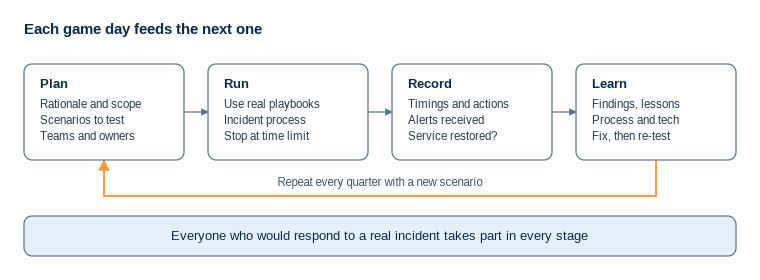
Each stage hands off to the next, and what you learn shapes the plan for the next game day.
Before the game day, write down:
- the rationale and scope
- the scenarios you will test
- the preparations needed
- the environment you will test in
- the plan, and the teams and stakeholders involved
During the game day, record:
- the timing of each scenario
- every action taken to investigate and fix the issue
- the observability reports and alerts you received
- how the incident management process ran
- whether the team brought the system back to normal operation
Set a time limit. If the exercise reaches it, stop. This protects the environment and keeps the exercise from disrupting other people’s work.
After the game day, capture your findings and lessons learned, from both a process and a technical point of view.
Services that help
You can run all of this by hand. If you want help, AWS Fault Injection Service injects failures in a controlled way, Amazon Route 53 Application Recovery Controller helps manage failover, and Amazon CloudWatch alarms and dashboards show whether your monitoring noticed. Check the current AWS documentation for capabilities and limits before you plan.
The scenario people forget
Most teams plan for a failed server or a lost Region. Fewer plan for the failure someone causes by accident: a bug in application code or infrastructure code, or a manual change that goes wrong. Add at least one self-inflicted scenario to your list.
Two mistakes to avoid
- Skipping your real incident process. Follow your incident management process and your disaster recovery playbooks, so teams do what they would do in a real incident.
- Leaving out important teams or people. Include everyone who would be pulled in during a real incident, in the planning and in the run.
The tradeoffs
- Time and attention. Game days take planning, people and a review afterward. In return, you learn from a rehearsal instead of a real incident.
- Risk to the environment. Injecting failures can cause wider impact than you intended. Scope tightly, and use the time limit to stop the exercise if needed.
- Manual or automated. Manual testing is cheaper to start and works well for the fundamentals. Automation costs more up front and makes frequent repeats easier. Larger organizations tend to automate, and smaller ones can begin by hand.
- Realism or safety. The closer a test is to production, the more you learn and the more you risk. Start in a non-production environment and move closer as the practice matures.
When not to run one yet
Skip the game day if you don’t have an incident management process, written playbooks for investigating an incident, or monitoring on the system. Build those first. A game day without them mostly proves what you already know.
Start small
A smaller team should focus on the fundamentals of each part of the game day. If you can’t run a live test yet, run a tabletop exercise, where everyone walks through the scenario and the playbook out loud. Larger organizations often automate their tests. A smaller one can inject failures by hand.
Cost and operations note
The main cost is people’s time, so schedule it and protect it. Start in a non-production environment, keep the time limit, and put a short list of findings into your backlog right away so the lessons don’t fade.
Why every quarter pays off
- Systems change between tests. New deployments and configuration changes mean last quarter’s result may no longer be true.
- Playbooks stay current. Each exercise shows which steps are stale, and the team updates them while the memory is fresh.
- Fixes get verified. Findings from one game day get re-tested in the next, so lessons turn into closed gaps.
- Teams build muscle memory. People rotate in and out, and regular practice keeps incident response from depending on a few veterans.
- Observability gets proven. Each scenario checks that alerts fire and dashboards show the problem as it happens.
- You have audit evidence. If you work in a regulated industry, a record of regular exercises shows that resiliency is a practice, not just a document.
The takeaway
A game day is as much about training your teams and validating your observability solution as it is about testing the architecture.